The Family
The Family is a way of understanding the cycles of living things and of the seasons as personified in a pantheon of deific, mythical figures. These are figures I have personally experienced and interacted with through ecstatic prayer and the induction of hallucinations, and have linked to mundane experiences and more concrete ecstacies.
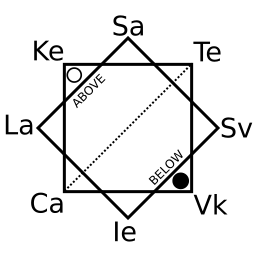
The Parents
The Parents are comparatively distant from the world, most present on single days in the calendar: the cross-quarter transitional days between seasons. They are more abstract, more conceptual, than the children, and we find them most in experiences, ideas, thoughts, and phenomena born of communication and connection among people, and between people and other living things. They are:
The Tessarine
The Tessarine is the disciplining parent and rules the summer/fall cross-quarter. The adjective tessarin describes things associated with her: long slogs through hot weather, the gnawing hunger of recognizing an error too late, and shame; but, also, he is the father of mental practice and physical training, of perseverence against desperate odds and long pain, and of triumph over obstacles that seem, at first, insurmountable.
The Tessarine is the first parent that revealed herself to me, and is dear to me and close to my heart. I do not always live up to what she expects of me, but she gives me strength to struggle on nonetheless.
The Keterine
The Keterine is the empowering parent and rules the spring/summer cross-quarter. The adjective keterin describes things associated with him: sparks of inspiration, surprising strength at a key moment, and earned confidence; but, also, she is the mother of headlong rushes into danger, boasts and unwise oaths, and of arrogance and pride.
The Tessarine and the Keterine are both male and female at once; they are neither men nor women, not being human, but they encompass masculinity and femininity in all their strangeness and beauty and difficulty. They can appear in masculine or feminine forms, but do not often entirely reject those trappings; they are bound by them as much as we are.
The Calycine
The Calycine is the is the nurturing parent and rules the winter/spring cross-quarter. The adjective calycin describes things associated with her.
He is named after the calyx, the part of the plant that covers and protects the flower before blooming.
The Vekarine
The Vekarine, is the watchful, distant parent who governs death and time and the fall/winter cross-quarter.
The Children
The Children represent the seasons of the year, with their correspondances particularly focused on how humans and other animals relate to them. The Parents created the Children in groups of three, composed of the two parents whose cross-quarters bound the child's season, plus the parent widdershins of those two.
We can also think of the children as lacking the influence of a single parent. Spring, for instance, can feel like it's devoid of discipline; food and warmth are plentiful and life is just at the beginning of its cycles, bursting forth from the ground and multiplying wantonly. The Lanicine, accordingly, was created by all parents except the Tesserine.
- Spring, named the Lanicine, child of the Calycine, Keterine, and Vekarine, is artistic, creative, and flighty, representing the directed will to change, rebellion, and progress.
- Summer, named the Samosine, child of the Keterine, Tesserine, and Calycine, is social, outgoing, and gossipy, representing tradition, celebration, order, and social connection.
- Autumn, named the Svepparine, the child of the Vekarine, Tessarine, and Keterine, is quiet and melancholy, representing rot, weathering, and gentle, slow failure: the warm death.
- Winter, named the Ieldine, the child of the Vekarine, Calycine, and Tessarine, is studious and withdrawn, representing preservation, stillness, and emptiness: the cold death.
Our Place in the Family
Where the seasonal Children are creations of three of the four Parents each, mortals are creations of all four. While an individual might feel a particular closeness to one or more of the Parents, we each contain aspects of discipline, empowerment, nurturing grace, and, ultimately, death and preservation.
In the family, we are equals of the Children; they are our siblings, not our parents or caretakers. We mortals, collectively, have just as much of an impact on the world as the seasons, and like them, our impact is not immutable.